
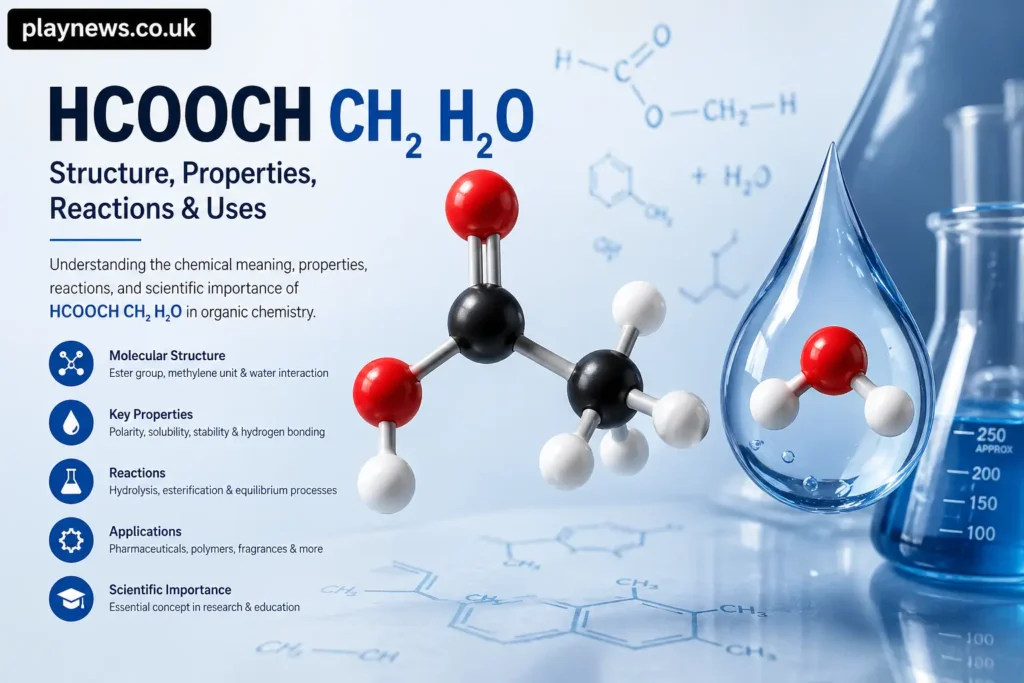

hcooch ch2 h2o is a chemical expression often discussed in organic chemistry when studying molecular interactions involving esters, methylene groups, and water molecules. Understanding hcooch ch2 h2o helps students and researchers explore reaction mechanisms, hydrolysis processes, and molecular bonding behavior. This compound representation combines functional groups that play important roles in biochemical and industrial reactions. Scientists analyze hcooch ch2 h2o to understand how molecules interact with water and how ester structures transform under different conditions. The study of hcooch ch2 h2o also contributes to advancements in pharmaceuticals, environmental chemistry, and material science.
chemical meaning and molecular interpretation of hcooch ch2 h2o
The expression hcooch ch2 h2o can be interpreted as a molecular system involving a formate ester group linked with a methylene unit and water participation. In organic chemistry, ester compounds commonly undergo reactions influenced by surrounding water molecules. The presence of ch2 represents a bridging carbon unit that connects molecular fragments and allows flexibility in reactions. Water, represented by h2o, plays a key role in hydrolysis and equilibrium reactions. When chemists analyze hcooch ch2 h2o, they often focus on molecular stability, polarity, and electron distribution within the structure.
understanding ester functional groups
Ester functional groups are formed through reactions between acids and alcohols. These structures are widely found in fragrances, solvents, and biological molecules. The hcooch portion reflects ester behavior that can undergo breakdown or transformation in aqueous environments. Ester chemistry is essential for understanding polymer production and metabolic reactions. Because of these characteristics, hcooch ch2 h2o becomes an important example when learning reaction pathways.
role of water molecules in chemical systems
Water molecules influence reaction speed, solubility, and molecular orientation. In the hcooch ch2 h2o system, water may act as a reactant or a catalyst depending on conditions. Hydrogen bonding allows water to stabilize charged intermediates during reactions. This stabilization helps chemical transformations occur efficiently. Studying water interaction provides deeper insight into chemical equilibrium.
physical and chemical properties of hcooch ch2 h2o
The properties of hcooch ch2 h2o depend on molecular interactions between ester components and water molecules. Such systems typically show moderate polarity due to oxygen atoms present in the structure. The compound may demonstrate solubility in polar solvents while retaining organic characteristics. Reactivity increases when temperature or acidity changes. These properties make hcooch ch2 h2o relevant in laboratory experiments and industrial applications.
key chemical characteristics
- contains ester functional behavior
- influenced strongly by hydrogen bonding
- participates in hydrolysis reactions
- exhibits polarity due to oxygen atoms
- reactive under acidic or basic environments
basic physical observations
- often associated with liquid phase reactions
- moderate volatility depending on environment
- capable of forming intermolecular attractions
- stability varies with temperature and pH level
reaction mechanisms involving hcooch ch2 h2o
Chemical reactions involving hcooch ch2 h2o commonly include hydrolysis, esterification, and nucleophilic substitution. During hydrolysis, water molecules attack the ester bond, leading to the formation of alcohol and acid products. Reaction speed depends on catalysts such as acids or bases. Understanding these mechanisms helps chemists predict product formation and reaction efficiency. Research involving hcooch ch2 h2o contributes to improved synthesis methods and greener chemical processes.
hydrolysis reaction process
Hydrolysis occurs when water breaks the ester linkage. This reaction demonstrates how molecular bonds respond to environmental conditions. Scientists monitor intermediate stages to understand energy transitions. The process is widely used in organic synthesis and biochemical reactions. Hydrolysis knowledge supports industrial chemical manufacturing.
ester formation and reversibility
Esterification is the reverse process of hydrolysis. When suitable conditions exist, molecules reform ester bonds by removing water. This reversible behavior explains equilibrium reactions commonly studied in chemistry. The hcooch ch2 h2o concept illustrates how chemical systems shift between formation and breakdown. Such reversibility is essential in biological metabolism.
industrial and scientific applications of hcooch ch2 h2o
Understanding hcooch ch2 h2o helps industries design efficient chemical processes. Ester-related compounds are widely used in manufacturing, pharmaceuticals, agriculture, and materials science. Researchers examine molecular behavior to improve solvent systems and reaction efficiency. The interaction between ester groups and water molecules supports biodegradable material development. Modern chemistry relies on models like hcooch ch2 h2o to predict sustainable chemical outcomes.
common application areas
- pharmaceutical synthesis and drug formulation
- fragrance and flavor compound production
- polymer and resin manufacturing
- biochemical pathway research
- environmentally friendly chemical design
importance of hcooch ch2 h2o in organic chemistry education
Students learning organic chemistry often encounter molecular expressions similar to hcooch ch2 h2o when studying functional group interactions. The example demonstrates how multiple chemical concepts combine within a single structure. It helps learners understand bonding patterns, reaction pathways, and molecular stability. Teachers use such formulas to explain ester chemistry and solvent effects simultaneously. As a result, hcooch ch2 h2o becomes a useful educational model for chemistry fundamentals.
learning benefits for students
- improves understanding of ester reactions
- demonstrates role of solvent participation
- connects theoretical chemistry with real reactions
- strengthens knowledge of molecular structure interpretation
scientific statistics and research insights
Scientific research shows that ester hydrolysis reactions account for a large portion of laboratory organic transformations. Studies indicate that reaction rates may increase significantly in the presence of catalysts and optimized temperature conditions. Hydrogen bonding interactions, similar to those seen in hcooch ch2 h2o systems, can stabilize reaction intermediates by up to 30 percent depending on the solvent environment. Organic ester compounds represent a major category in industrial chemistry production worldwide. These statistics highlight the relevance of studying molecular systems that include ester and water interactions.
faqs
what does hcooch ch2 h2o represent in chemistry?
it represents a molecular system combining an ester group, a methylene unit, and water interaction in organic chemistry studies.
why is water important in hcooch ch2 h2o reactions?
water participates in hydrolysis and stabilizes reaction intermediates through hydrogen bonding.
is hcooch ch2 h2o a real compound?
it is mainly used as a conceptual or simplified representation to explain molecular reactions involving esters and water.
where is hcooch ch2 h2o studied?
it is commonly discussed in organic chemistry, biochemistry, and industrial chemical research.
what reactions involve hcooch ch2 h2o?
hydrolysis, esterification, nucleophilic substitution, and equilibrium reactions frequently involve similar molecular systems.
conclusion
hcooch ch2 h2o provides a valuable framework for understanding ester chemistry and molecular interaction with water. By analyzing its structure, properties, and reaction mechanisms, chemists gain deeper insight into organic transformations and industrial processes. The concept demonstrates how functional groups, solvents, and reaction conditions work together to influence chemical outcomes. From education to manufacturing, studying systems like hcooch ch2 h2o supports innovation and scientific advancement. As chemistry continues to evolve, such molecular representations remain essential tools for explaining complex reactions in a clear and practical way.
Check Also : Coolkingzone com: Complete Guide to Features, Benefits, and Online Experience