
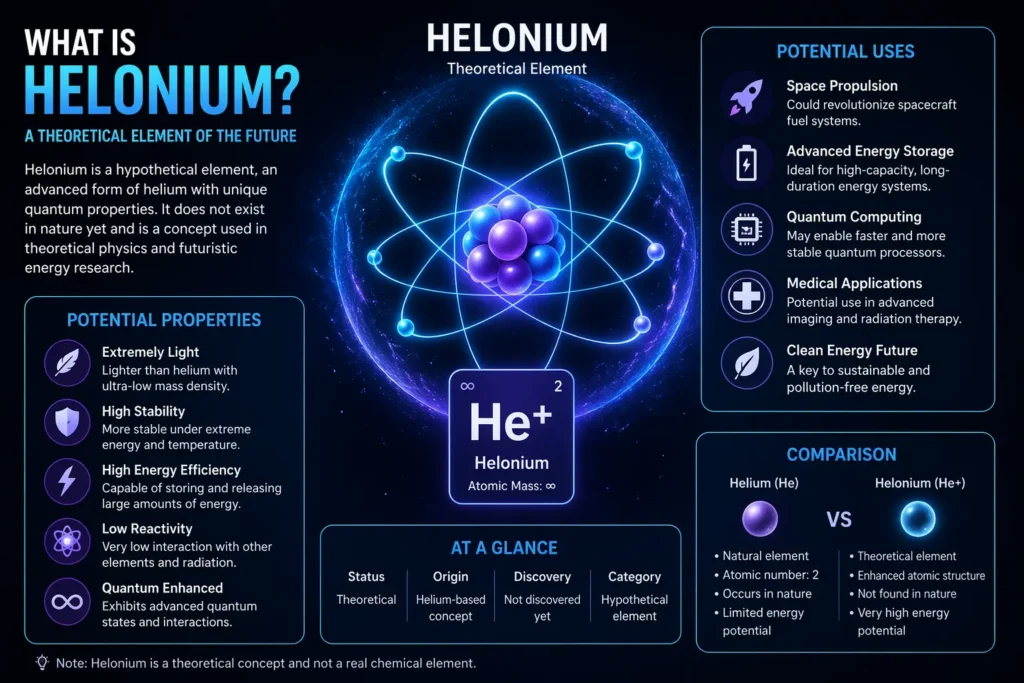

Helonium is a theoretical scientific concept often discussed in advanced physics and speculative chemistry. It is not a confirmed chemical element in the periodic table, but rather an imagined or model-based form of matter derived from helium-like atomic structures. Scientists and science writers use Helonium as a conceptual tool to explore how atoms might behave if their structure were altered under extreme quantum or energy conditions. This makes Helonium more of a thought experiment in modern physics than a real-world substance.
In simple terms, Helonium can be understood as a hypothetical “enhanced helium” state where atomic behavior is modified beyond natural limits. It is commonly used in theoretical discussions about quantum mechanics, high-energy physics, and futuristic material science. The idea helps researchers imagine what new forms of matter could exist if current scientific boundaries were expanded. Because of this, Helonium is frequently referenced in futuristic research models and science fiction narratives.
What Exactly is Helonium?
Helonium is best described as a non-existent but scientifically inspired concept. It is imagined by taking helium, one of the simplest and most stable elements, and altering its atomic structure in theoretical ways. These alterations are not physically proven but are useful in simulations and abstract physics modeling. Helonium is often used to represent how matter might behave under unknown or extreme quantum forces.
In many explanations, Helonium is considered a bridge between known physics and unknown possibilities. It helps scientists think about how atoms could be redesigned or manipulated at the subatomic level. While helium exists naturally and is well understood, Helonium exists only in theoretical discussions. This distinction is very important in understanding its role in science.
Scientific Background of Helonium
The concept of Helonium is influenced by quantum physics and atomic theory. In quantum mechanics, particles can behave in unusual and unpredictable ways under certain conditions. Helonium is used as a model to explore these behaviors in a controlled theoretical environment. It allows scientists to simulate how modified atoms might interact with energy fields and radiation.
Helonium also appears in discussions about exotic matter and advanced energy systems. These ideas explore what could happen if atomic bonds were strengthened or redesigned beyond natural limits. While Helonium is not real, it helps expand scientific imagination and encourages deeper research into atomic behavior. This makes it valuable in academic and theoretical studies.
Why Helonium is Important in Theory
Even though Helonium does not exist, it plays an important role in scientific thinking. It helps researchers test ideas about energy efficiency, atomic stability, and quantum interactions without physical limitations. By imagining Helonium, scientists can explore what might be possible in future technologies.
Key theoretical importance of Helonium
- Helps model advanced atomic behavior
- Supports quantum physics simulations
- Encourages innovation in material science
- Useful in futuristic energy system theories
- Expands understanding of exotic matter concepts
Helonium is especially useful in futuristic research planning, where scientists attempt to predict what new forms of energy or matter might look like in the future.
Helonium in Modern Science Discussions
In modern scientific discussions, Helonium is often used as a placeholder concept for unknown atomic possibilities. It is not treated as a real discovery but as a way to explore ideas beyond current limitations. Researchers sometimes use Helonium to represent hypothetical states of matter that could exist under extreme conditions such as deep space or high-energy environments.
Helonium also appears in educational contexts, where it is used to explain how theoretical physics works. It helps students understand how science builds models even for things that cannot yet be proven. This makes Helonium a useful learning concept in advanced science education.
FAQ about Helonium
Q1: What is Helonium in simple terms?
Helonium is a theoretical version of helium imagined in advanced physics studies.
Q2: Does Helonium really exist?
No, Helonium is not a real element and has not been discovered in nature.
Q3: Why is Helonium studied in science?
It helps scientists explore ideas about atomic structure and futuristic energy systems.
Q4: What makes Helonium interesting?
Its imagined properties like stability, low mass, and energy efficiency make it fascinating.
Q5: Can Helonium be used in the future?
It is currently theoretical, but it inspires future energy and technology research.
Conclusion
Helonium is a fascinating theoretical idea that represents the boundaries of modern scientific imagination. While it is not a real element, it plays an important role in helping scientists explore advanced concepts in physics and chemistry. By studying Helonium as a model, researchers can better understand how matter might behave under extreme or unknown conditions.
Ultimately, Helonium stands as a symbol of future scientific possibility, showing how human curiosity continues to push the limits of knowledge beyond the periodic table.